

Target volumetric flow rates for large power tools range from 300-600 ft3/min.
According to Sandor Nagyszalanczy’s 2002 Woodshop Dust Control, in ducts, we want the flow rate to be at least 4000 ft/min. If the flow rate is slower, dust particles drop out of the air and clog the ducts, which further reduces the flow rate.
There are several different standards for how much dust exposure is okay, all measured in mg/m3. OSHA has two different limits: 15 mg/m3 for total dust in the air, 5 mg/m3 for respirable dust. By “respirable” dust, OSHA means particles in the size range which would be deposited in the gas-exchange region of the lung, which are particles around 4um or smaller. More details are available in the classic paper, “Respirable Aerosol Sampler Performance Testing,” by Bartley, et al., 1994.
The NIOSH standard is more strict: 1 mg/m3.
The dust collector we have for the table saw, band saw, and planer is a 2018 PFlux1 from Laguna Tools. The machine’s performance curve is below.
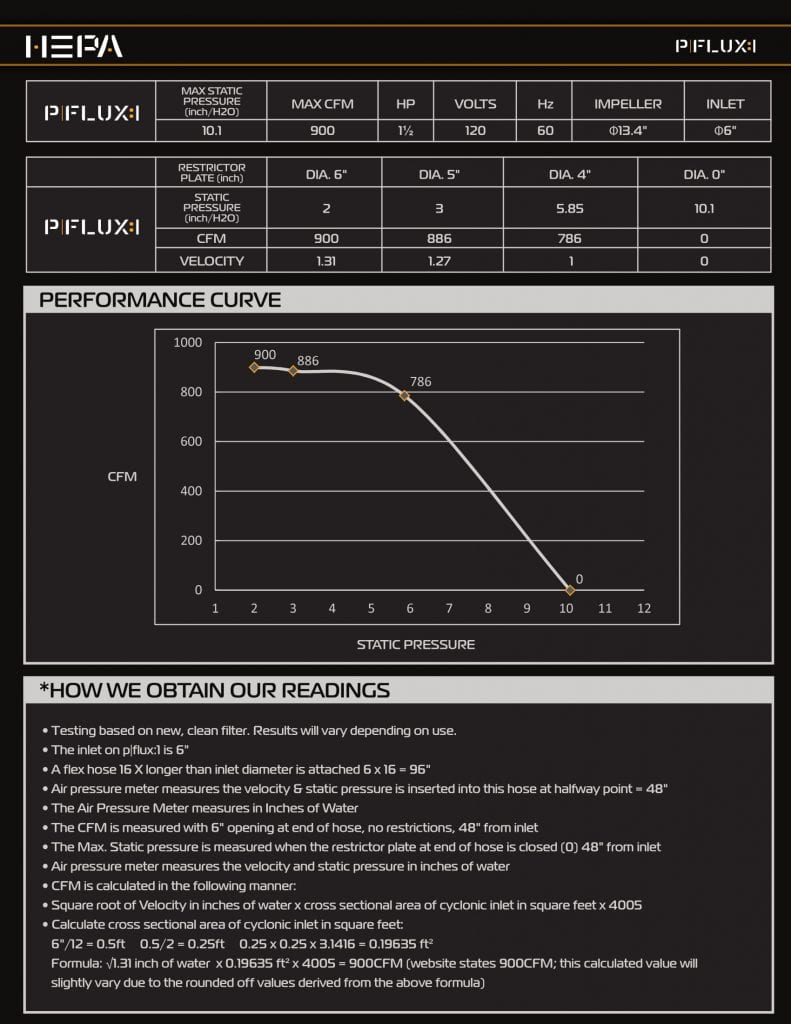
Laguna claims that “The P|Flux filter cartridge is a HEPA filter that filters out 99.97% of particles with a size of 0.3 microns.” Nagyszalanczy mentions that particles below 0.3 μm “are small enough to be expelled by exhalation” (p. 11).
For measuring dust, we’re using a Dylos DC1100 Pro air quality monitor, which measures dust in two different sizes, 0.5+ μm and 2.5+ μm, reported in particles per 0.01 ft3.
We can convert from the Dylos measurement in particles per 0.01 ft3 to mg/m3 with this method recommended by Dylos (via email to me, June 2026):
“take the difference between the two readings, the .5 and the 2.5, then divide by 100 to get micrograms per cubic meter PM 2.5 this has been shown to work across a wide variety of typical kinds of air pollution environments like city countryside. We’ve had a lot of feedback on this formula and it gives a pretty decent estimate and it’s simple. I’ve had formulas derived from estimating particle mass and they are almost always farther off. Consider many particles are much denser even 2 or 3 times your wood estimate. Plus there’s a sizable fraction of particles smaller than 0.5um that contribute to the PM2.5”